


The conversation about AI keeps getting flattened into a false choice: either you are alarmed by the harm, or you are excited by the benefit. Either you condemn it outright, or you defend it. That framing is making the conversation worse.
People are angry, and they have every reason to be. They are angry about water use, energy demand, labor displacement, and the fact that communities are often forced to carry costs they did not choose so that someone else can enjoy the convenience. That anger is not irrational. It is morally coherent.
But the opposite mistake is just as corrosive: pretending AI offers nothing meaningful to ordinary people. It does. It is reducing the cost of help that used to be reserved for people with money, institutional knowledge, or professional access. Solo business owners are doing the work of a team. Caregivers are getting time and clarity they cannot get in a rushed medical system. Writers without gatekeepers, disabled people needing support, and first-generation students navigating opaque systems are gaining tools they did not have before. That matters.
This is the reality critics and enthusiasts alike often try to avoid: the harms are real, and the benefits are real, and they are not falling on the same people. Communities near data centers bear the environmental burden. Users elsewhere collect the gains. That is not just a technical issue or a market issue. It is a justice issue.
So no, the answer is not to pick a team.
The answer is to get more honest. Individual restraint is not the main solution. These systems operate whether or not any one person opts in. The bigger questions are about infrastructure, energy, siting, and regulation. If we want better outcomes, the target has to be policy, not just personal guilt.
We also need better comparisons. The real question is not whether AI is worse than doing nothing. The real question is what it replaces: driving, printing, hiring, or abandoning a task entirely. Sometimes AI is the lower-impact option. Sometimes it is not. Serious analysis starts there.
What this debate needs is not less anger. It needs better direction. Anger is often the clearest signal that something unjust is being normalized. The issue is not whether people should feel it. The issue is whether that feeling gets turned into pressure for structural change.
If we keep forcing this conversation into tribes, we will miss the truth in front of us: AI is producing real harm and real benefit at the same time. Pretending otherwise may be convenient, but it is not honest.
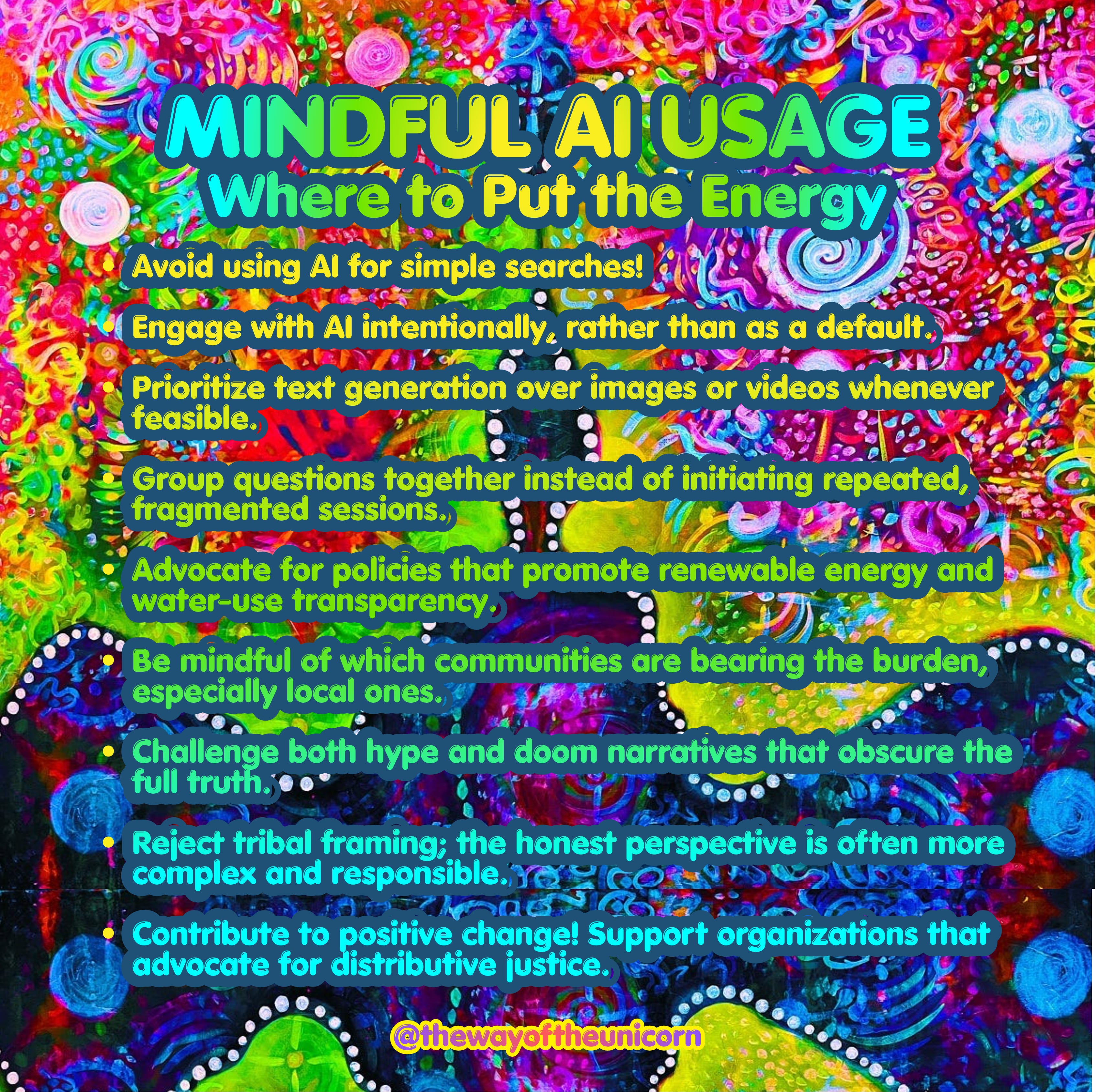
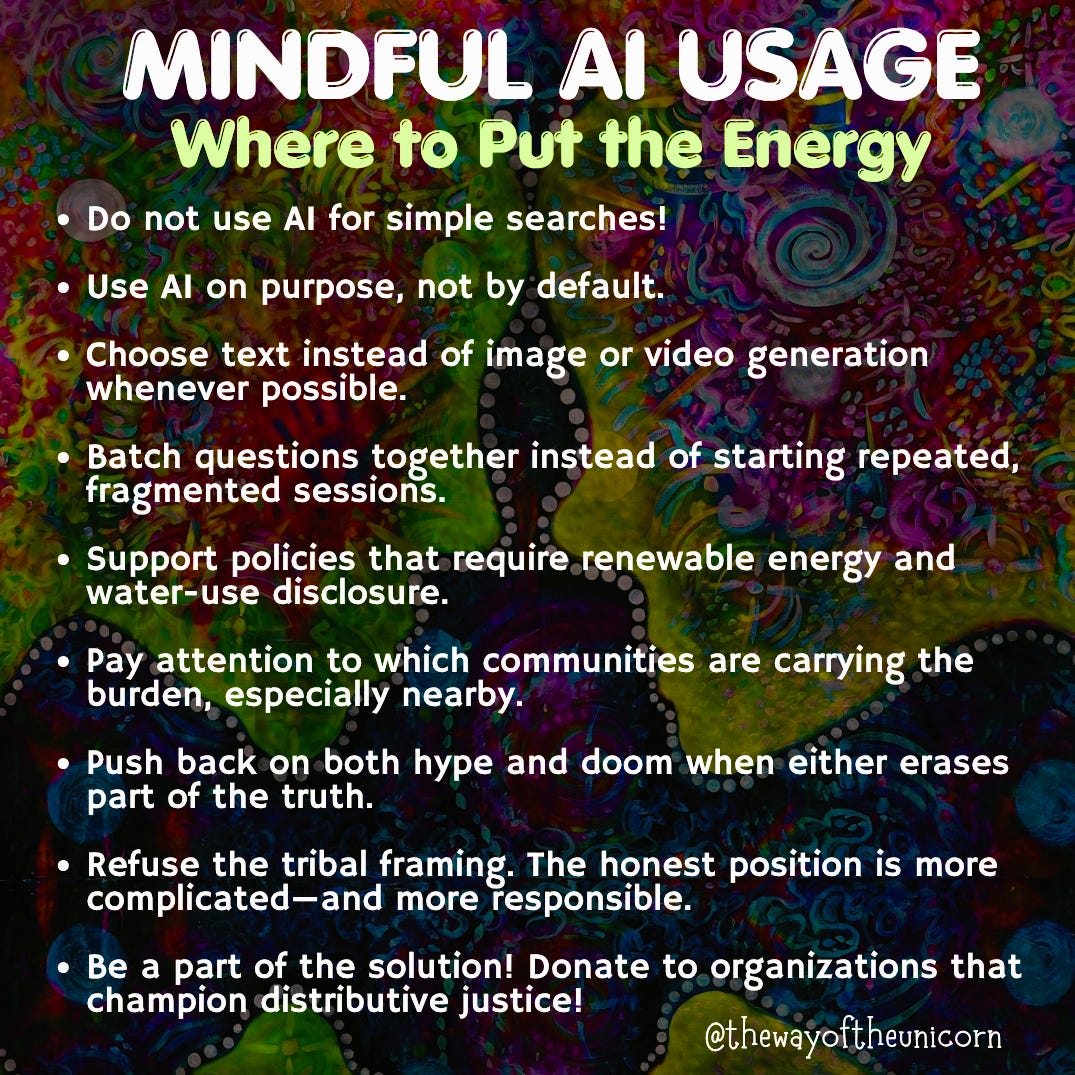
MINDFUL AI USAGE
Where to Put the Energy
Avoid using AI for simple searches!
Engage with AI intentionally, rather than as a default.
Prioritize text generation over images or videos whenever feasible.
Group questions together instead of initiating repeated, fragmented sessions.
Advocate for policies that promote renewable energy and water-use transparency.
Be mindful of which communities are bearing the burden, especially local ones.
Challenge both hype and doom narratives that obscure the full truth.
Reject tribal framing; the honest perspective is often more complex and responsible.
Contribute to positive change! Support organizations that advocate for distributive justice.
In the end, how we move through this moment is still a choice. We can retreat into suspicion and camps, or we can work together with honesty, restraint, and care for the people most affected by the systems we build. I still have faith that, if we are willing to stay clear-eyed and humane, goodness can prevail—not by accident, but by what we choose to protect, repair, and build together.
With Love & Paint & Stardust,
Ashley Stardust Unicorn oxo
💚🌈🌟🦄💜

Great article♥️ thank you for clarifying the both sides of the coin..
Beautifully expressed. Thank you.
YES YES YES to
We can retreat into camps or work together with honesty, restraint, and care and to humane goodness can prevail—not by accident, but by what we choose to protect, repair, and build together.